
Fake Colored Contacts: 9 Warning Signs and the Dangerous Risks to Your Eyes

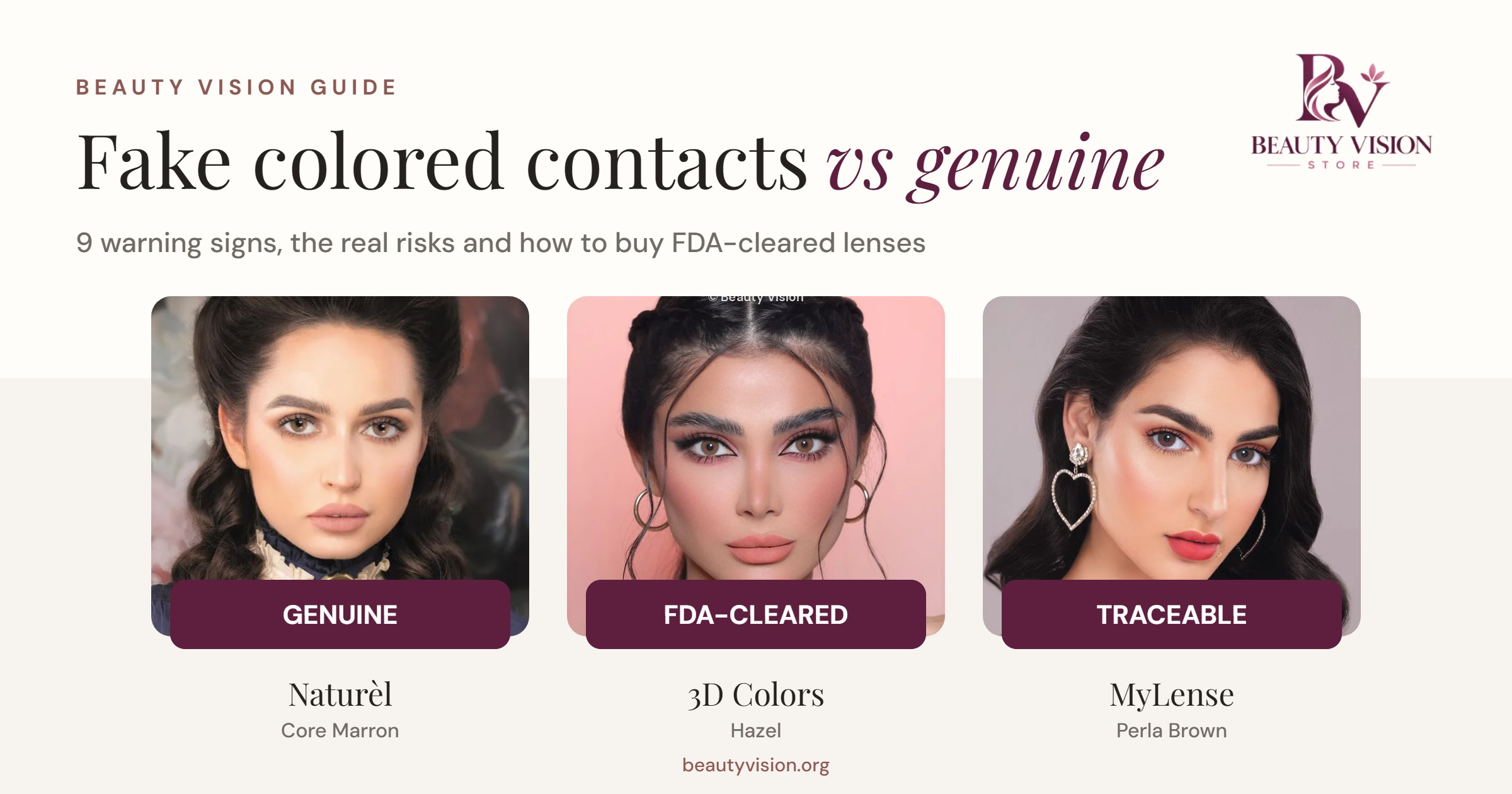
Fake colored contacts are everywhere: on street stalls, in costume shops, at flea markets, in beauty supply stores and on online stores that ship a box with no questions asked. They look cheap and harmless, but a contact lens is a medical device that sits directly on the cornea, and a lens that was never checked, fitted or prescribed can hurt your eyes in a single day of wear.
This guide explains what fake colored contacts and counterfeit contact lenses really are, why costume contacts sold without a prescription are illegal in the United States, the warning signs that a lens or a seller is not genuine, and how to buy colored contacts that are safe, cleared and traceable.
What counts as fake colored contacts?
“Fake” covers more than one problem. When eye doctors talk about fake colored contacts, they usually mean one of these:
- Counterfeit contact lenses: copies of a real brand, sold in look-alike boxes, with materials and colors nobody has tested.
- Unapproved lenses: lenses that were never cleared or approved by the FDA, often sold as costume contacts or “one size fits all” novelty lenses.
- Grey-market lenses: real lenses sold outside legal channels, without a prescription check, so you cannot know how they were stored or whether they fit your eye.
- Expired or tampered lenses: old stock or opened vials resold as new.
All four share the same problem: nobody stands behind what is touching your eye.
Are costume contacts illegal in the US?
In the United States, the FDA regulates every contact lens as a medical device, including purely decorative ones with no vision correction. According to the FDA’s page on decorative contact lenses, lenses that were not prescribed by an eye doctor are illegal to sell and can cause harm. The FDA lists street vendors, flea markets, beauty supply stores, novelty shops and Halloween stores among the places where you should not buy them.
That is why costume contacts and fake colored contacts so often appear around Halloween, festivals and cosplay events: the sellers count on people treating lenses like makeup. They are not makeup. A legitimate seller asks for a prescription and verifies it with your eye doctor, even for plano lenses with no power. If you are not sure whether you need one, read our guide to plano colored contacts.

The real risks of fake colored contacts
The FDA lists the most common problems with unprescribed and counterfeit contact lenses:
- Corneal abrasion: a scratch on the outer layer of the eye, often from a lens that does not fit your eye’s curve.
- Allergic reactions: to unknown dyes or materials.
- Infection: from contaminated lenses, dirty packaging or unsafe solution.
- Decreased vision: including blurry vision that can last after you remove the lens.
- Blindness: in severe cases of untreated infection.
The FDA also notes that lenses can cause damage even when you feel no symptoms at all. So the fact that fake colored contacts “felt fine” for one evening does not mean they were safe.
Why fit matters, even with no prescription power
Every eye has its own size and curve. A lens that is too tight can press on the eye and limit the oxygen that reaches it; a lens that is too loose can slide and rub. A genuine lens is made to stated measurements, such as base curve and diameter, printed on the box, so your eye doctor can check that it suits you. Counterfeit contact lenses often have no reliable measurements at all.
Why the color layer matters
In a properly made colored lens, the pigment is sealed inside the lens material. In Beauty Vision lenses, multi-layer color encapsulation keeps the color from touching your eye. In fake colored contacts, nobody knows where the pigment sits, what it is made of or whether it can rub off.
9 warning signs of fake colored contacts and counterfeit contact lenses
- No prescription needed. In the US, a seller that never asks for a prescription is not following the law.
- One size fits all. Real lenses list a base curve and a diameter.
- No manufacturer named. The box should name the manufacturer and the country where it was made.
- No lot number or expiry date. Every genuine vial and box carries both.
- Broken seals or loose vials. Lenses should arrive sealed, never in open cases or plastic bags.
- Spelling mistakes and blurry printing on the box, the vial or the leaflet.
- No instructions. Genuine lenses come with wear and care directions.
- A price that seems impossible for the brand, or a “brand” you cannot find anywhere else.
- Sold next to party supplies at a market stall, flea market or novelty shop.
If you see even one of these signs, do not put the lens in your eye.
How to check a box of colored contacts before you wear them
Whether you bought online or in a store, take two minutes to check the box before the first wear. Genuine lenses pass every one of these checks; fake colored contacts usually fail at least one.
| Check | Genuine lens | Warning sign |
|---|---|---|
| Manufacturer | Named, with country of manufacture | No name, or only a logo |
| Measurements | Base curve, diameter and power printed | “One size fits all” |
| Lot and expiry | Printed on box and vial | Missing or scratched off |
| Seal | Sealed blister or vial | Opened, leaking or loose |
| Instructions | Leaflet with wear and care directions | None, or a photocopy |
| Seller | Asks for and verifies a prescription | Sells with no questions |
Beauty Vision lenses are made by Vassen Co., Ltd. in Korea, with a base curve of 8.6 mm. If any detail you expect is missing from a box you receive, contact us before you wear the lenses.
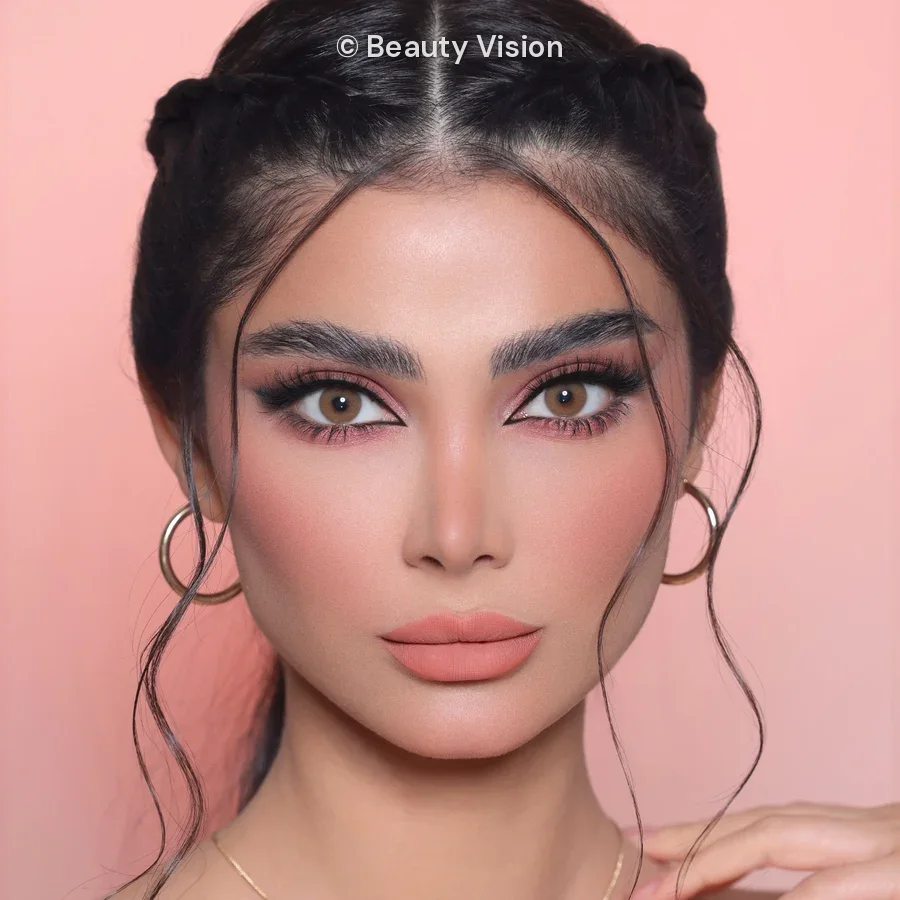
Fake colored contacts vs genuine lenses
Here is what separates genuine lenses from counterfeit contact lenses and unapproved costume contacts:
- Clearance: genuine lenses are cleared or approved by the FDA for sale in the US. Beauty Vision lenses are FDA-cleared under 510(k) K141699.
- Quality system: genuine lenses are made under a medical-device quality system. Ours are produced under ISO 13485 and carry the CE mark.
- Known material: Beauty Vision lenses are made of polymacon with 38% water content.
- Traceability: genuine lenses carry a lot number, so a lens can be traced back to its batch.
- A seller who answers: a real store has a returns policy, customer service and a company name behind it. At Beauty Vision, unopened boxes can be returned within 7 days with approval.
Read how a genuine lens is produced, step by step, in our guide on how colored contacts are made.
Costume contacts for Halloween and events: the safe way
You do not need fake colored contacts to get a striking look for Halloween, a party or a photo shoot. Bold shades from genuine brands give you a dramatic change with the same safety checks as everyday lenses:
- Icy and otherworldly: MyLense Oro Ice, an icy blue-gray with a bright metallic shine.
- Bright and electric: Wonder Look Navy, a bright sky blue with a defined outline.
- Snowy: MyLense Perla Dove, a snowy gray for a completely different eye color.
- Deep and warm: 3D Colors Ochre, a deep chocolate brown in layered color.
For a single event, a daily lens is the easiest choice: you open a fresh pair and throw it away at the end of the night. See our guide to Wonder Look daily colored contacts.
What to do if you already wore fake colored contacts
If you wore costume contacts or lenses you are not sure about:
- Take them out and do not wear them again.
- Watch for warning signs of infection listed by the FDA: redness, eye pain that does not go away after a short time, decreased vision, or discharge.
- See an eye doctor right away if you notice any of them. The FDA warns that an untreated eye infection can lead to blindness.
- Keep the box and receipt, if you have them, to show your doctor.
- Report it. The FDA asks people to report problems with contact lenses through MedWatch, and suspicious sellers to the FDA or the Federal Trade Commission.
Where to buy colored contacts safely
The FDA’s advice is simple: get an eye exam, get a prescription, and buy from your eye doctor or a company that sells FDA-cleared or approved lenses and asks for a prescription. Avoid unknown online sellers, because their lenses may be contaminated or counterfeit contact lenses.
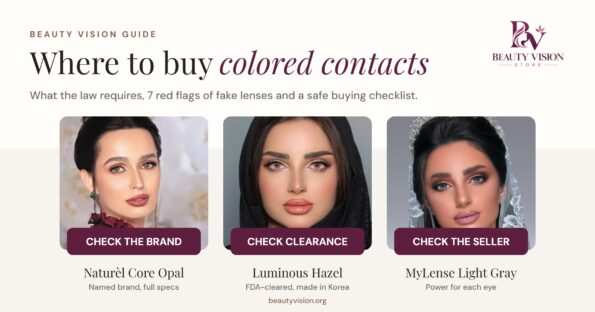
For a longer checklist, read our guide on where to buy colored contacts safely, and our answers to the question are colored contacts safe?
How to vet an online store before you order
Most fake colored contacts today are sold online, often through ads, marketplaces and social media shops that disappear after a few weeks. Before you order from any website, run through this checklist:
- Does it ask for a prescription? A US seller should ask for your prescription, or your eye doctor’s name and phone number, so it can verify it.
- Does it name the company? Look for a real company name, an address and a way to contact a person.
- Does it name the manufacturer? A product page should say who makes the lens and where.
- Does it list specifications? Material, water content, base curve, diameter, available powers and replacement schedule should all be stated.
- Does it state its clearances? A seller of cleared lenses can tell you which clearance applies.
- Does it have clear policies? Shipping times, returns and customer service should be written down before you pay.
- Do the photos match? Be careful when the same lens photos appear on many unrelated sites under different brand names.
If a website fails several of these checks, treat its lenses as possible counterfeit contact lenses and shop elsewhere.
Who buys fake colored contacts, and why
People rarely set out to buy fake colored contacts. More often, they end up with them because:
- They want a look for one night, such as Halloween, a festival or cosplay, and buy costume contacts on impulse.
- They think plano lenses are cosmetics, like a lipstick or a nail color, and do not know a prescription is needed.
- They trust a familiar brand name on a box that turns out to be a copy.
- They are trying colored lenses for the first time and do not yet know what a genuine box looks like.
- They share lenses with a friend who bought them somewhere unknown.
Knowing these situations makes it easier to stop and check before the lens goes into your eye. If you are new to colored lenses, start with our beginner’s guide to colored contacts.
Genuine lenses are about more than color
Two lenses can look identical in a photo and still be completely different products. A genuine colored lens is a medical device with a known material, a known water content, stated measurements, a tested color layer, a lot number and a manufacturer who is responsible for it.
Costume contacts and counterfeit contact lenses may copy the color, but none of the rest. When you choose a lens, you are choosing everything you cannot see as well as the shade you can.
That is the real difference between fake colored contacts and a lens you can trust: not how it looks on the first day, but what stands behind it every day you wear it. A brand that names its manufacturer, states its clearance and answers your questions gives you something no street stall can.
Myths about fake colored contacts
“Plano lenses don’t need a prescription.”
In the US they do. Plano means no vision correction, not no fitting. The FDA treats decorative lenses as medical devices like any other contact lens.
“If they feel comfortable, they’re fine.”
Not necessarily. The FDA notes that lenses can cause damage without symptoms. Comfort alone does not tell you a lens fits or is clean.
“Costume contacts are only for one night, so it doesn’t matter.”
One night is enough for a scratch or an infection. A single-use daily lens from a genuine brand is the safe way to wear a look for one night.
“A big brand name on the box means it’s real.”
Counterfeit contact lenses copy real brand names and box designs. Buy from the brand’s own store or an authorized seller, and check the lot number and expiry date.
Safe habits that protect your eyes with any lens
- Wash and dry your hands before you touch your lenses.
- Use fresh contact lens solution every time, never water or saliva.
- Follow the replacement schedule on the box: daily, monthly or 3-month.
- Do not sleep in your lenses unless your eye doctor says you can.
- Never share lenses with friends, even for one photo. The FDA warns that lenses are fitted to one person’s eyes.
- Keep follow-up visits with your eye doctor.
- If a lens hurts, take it out. Our guide on why colored contacts hurt explains the common causes.
And keep your case clean: our guide on how to clean colored contacts walks you through it.
Frequently asked questions
How can I tell if colored contacts are fake?
Check for a named manufacturer, printed measurements, a lot number, an expiry date, a sealed vial and instructions. A seller that never asks for a prescription is a warning sign in itself.
Are fake colored contacts dangerous?
Yes. The FDA lists corneal scratches, allergic reactions, infection, decreased vision and, in severe cases, blindness as risks of unprescribed lenses.
Is it illegal to sell costume contacts without a prescription?
In the US, yes. The FDA says lenses that were not prescribed by an eye doctor are illegal and can cause harm.
Are counterfeit contact lenses sold online?
Yes. The FDA warns that unknown online distributors may sell contaminated or counterfeit lenses. Buy from a company that sells cleared lenses and asks for a prescription.
Are Beauty Vision colored contacts FDA-cleared?
Yes. They are FDA-cleared under 510(k) K141699, made in Korea by Vassen Co., Ltd. under ISO 13485, and CE marked.
What should I do if my eyes hurt after wearing costume contacts?
Remove the lenses and see an eye doctor right away, especially if you have redness, pain, discharge or blurry vision.
Why choose Beauty Vision
Beauty Vision is the online store of Diamond Eye, the company behind Luminous, Naturèl, MyLense, Wonder Look, 3D Colors and Élite, with more than 150 shades. Our lenses are made in Korea by Vassen Co., Ltd. under ISO 13485, CE marked and FDA-cleared under 510(k) K141699. Most shades come in plano and from −0.50 to −8.00; 3D Colors is available from −0.50 to −5.00 for now, with −5.50 to −8.00 coming soon. Orders ship from the UAE and reach the US in 1 to 5 business days, and US orders need a valid prescription, including plano lenses.
Skip fake colored contacts and choose a lens you can trace.
This guide is for general information and is not medical advice. Always follow your eye doctor’s instructions and the directions on your lens packaging.

 USD
 AED
 KWD
 OMR